
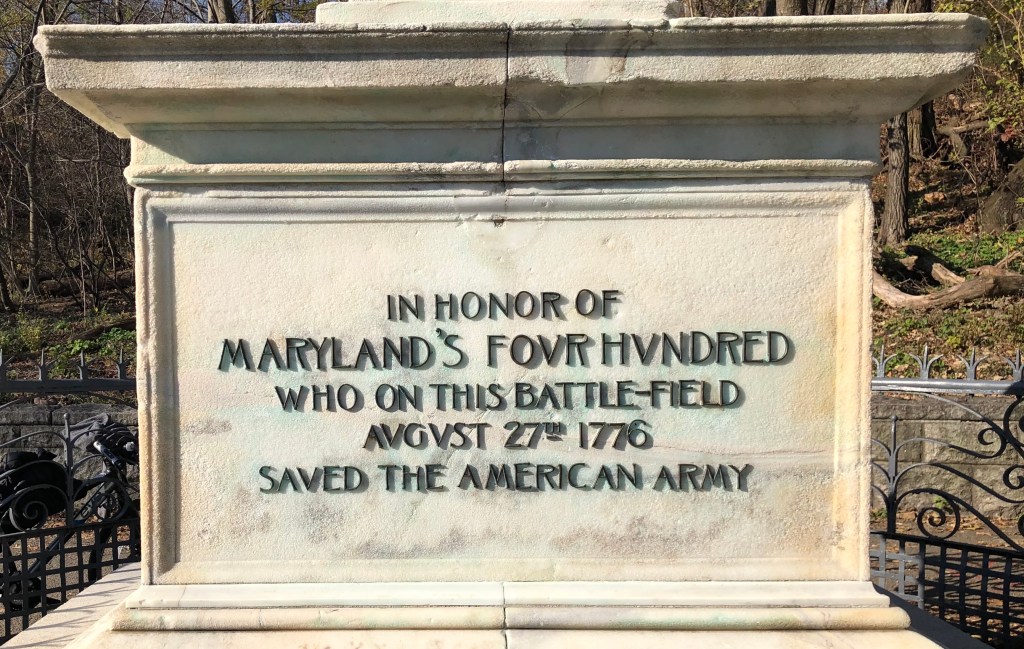
On the afternoon of August 27, 1776, along the east bank of Gowanus Creek in Brooklyn, approximately 400 American colonial soldiers stood witnessing their country being overrun by 20,000 soldiers of the British Empire.
These men were part of the First Maryland Regiment, which had been raised by that colony following the Declaration of Independence and sent to help George Washington defend New York City against an anticipated British assault. When that invasion occurred, the American defenses collapsed, and Washington’s army was sent reeling through Brooklyn with desperate hopes of evacuating across the East River to Manhattan. The 400 had gotten bogged down in the marshy Brooklyn terrain and trapped along Gowanus Creek, leaving them at the mercy of an overwhelming enemy force bearing down on them.
And then, in this moment, they did something quite extraordinary. Rather than try to wade the creek or surrender, the Maryland 400, under Colonel William Smallwood and Major Mordecai Gist, turned and faced the enemy, and launched a counterattack. For the next hour, this tiny force engaged the British in brutal combat in and around a Dutch stone farmhouse. General Washington, watching the action from Brooklyn Heights through a spy glass, is reported to have said, “Good God, what brave fellows I must this day lose!’
The carnage of this action is revealed in the gruesome statistics. On this day, the First Maryland lost 256 men killed and had 100 taken prisoner. Some companies lost over 80% of their men. Only a few survivors came back, including Major Gist, who would survive the war and witness the ultimate victory at Yorktown in 1781.
But their heroism in this moment gave George Washington the desperate extra hour he needed to coordinate and complete the evacuation of his army across East River, and save the dwindling hopes of the American Revolution.
For their action, these men, known as the “Maryland Line,” are commemorated in the state motto of Maryland, “The Old Line State.”
(Unfortunately, little is certain about their ultimate fate. Some historians believe the 256 dead troops were buried in a mass grave near what is today 3rd Avenue between 7th and 8th Streets, perhaps under an auto repair shop. The Maryland Society of the Sons of the Revolution believe there was no mass burial site and the bodies were left scattered on the field, and are now covered by modern development. Several archaeological digs have found nothing.)


Leave a Reply