
In New Jersey, a soldier’s blood runs blue.
Back in 1673, the little town of Piscataway was at the bleeding edge of the British-American frontier. The Raritan River runs west from there up into the Jersey high ground, and in the summertime the natives would commonly come down it to hunt and fish along the banks. This eventually led to conflict with English settlers. In response, the Colony of New Jersey established a military unit to deal with any natives who made “a general nuisance of themselves by burning hay stacks, corn fodder and even barns.” It was called the Jersey Provincial Regiment, and it was one of the first British militia forces in America.
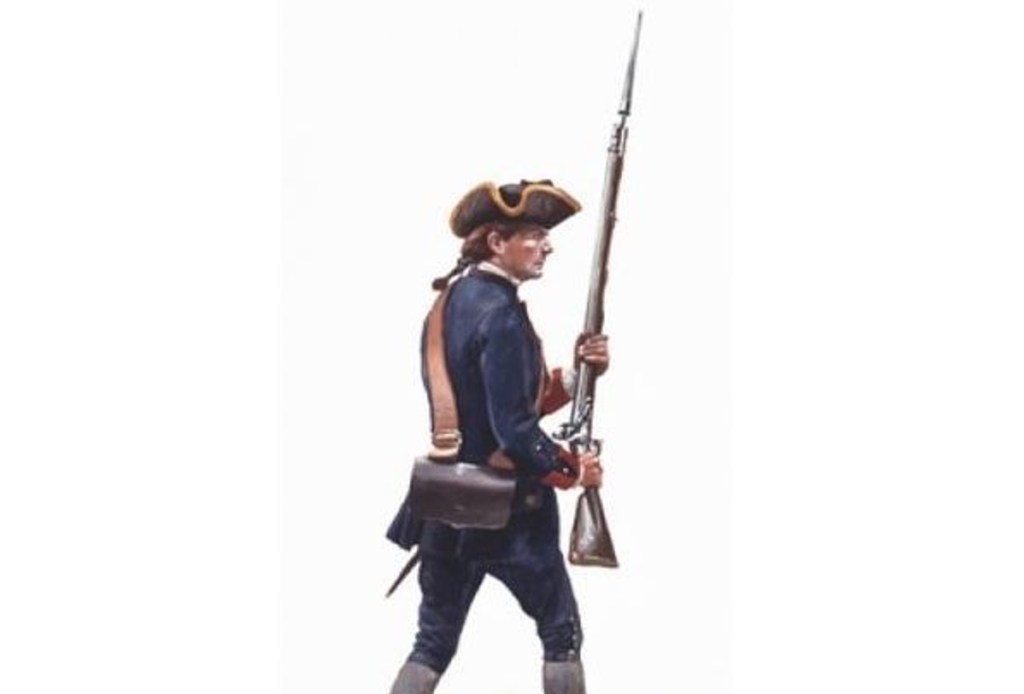
They were pretty easy to recognize. They wore blue coats and breeches, highlighted by red waistcoats, lapels and cuffs. Over time, the uniform became iconic and pretty much synonymous with what an American militiaman looks like. No surprise, then, that they were commonly referred to as the “Jersey Blues.”
You’ve seen them before. During the French and Indian War, their responsibilities had expanded beyond defending against native border incursions, and they were being deployed to all sorts of dangerous frontier places where British America and French America were rubbing up against each other. You may remember a scene from “Last of the Mohicans” where the British are evacuating Fort William Henry at Lake George, with a long line of retreating blue-clad soldiers and civilians strung out along a lonely forest road. Suddenly, the woods on either side explode with gunfire and the cries of natives loyal to the French, and a vicious massacre ensues. Though not entirely historically accurate, that scene pretty well sums up the role and the risks for militiamen like the Jersey Blues in colonial America.
And then came Lexington and Concord in the spring of 1775. As news of that rebellion spread down the coast, each colony had a decision to make about its loyalty to the Crown. In New Jersey, there was a curious Scotsman with a failed claim to a European title and a taste for expensive wine. Though he would prove himself a patriot, he went by the name Lord Stirling. As Jerseyans started collecting around the idea of Independence, Stirling took charge of the Jersey Blues, began patrolling the colony, and facing off against Loyalists. The ensuing violence would be the first actions of what will blow up into a civil war in New Jersey that will last for the remainder of the American Revolution.
Meanwhile, the Second Continental Congress was meeting nearby in Philadelphia. Sometime in September, it received King George’s rejection of the Olive Branch Petition that they had sent to him that previous July. And from that point, the way forward will be abundantly clear. Congress will make what was basically already happening completely official. And they will give the Jersey Blues a new name.
At the beginning of October, 1775, they will reorganize and rechristen New Jersey’s forces. Under Colonel Lord Stirling, over 700 men from eight of New Jersey’s eastern counties will form the “1st New Jersey Regiment.” A similar “2nd New Jersey Regiment” would come from five western counties, under the command of Colonel William Maxwell.
In the deadly years to come, folks will continue to commonly refer to these blue-and-red-clad soldiers as Jersey Blues. But from this point forward, these fearsome American soldiers will be technically known as “The Jersey Line of the Continental Army.”
 Revolution250.blog
Leave a comment